Your Cart is Empty


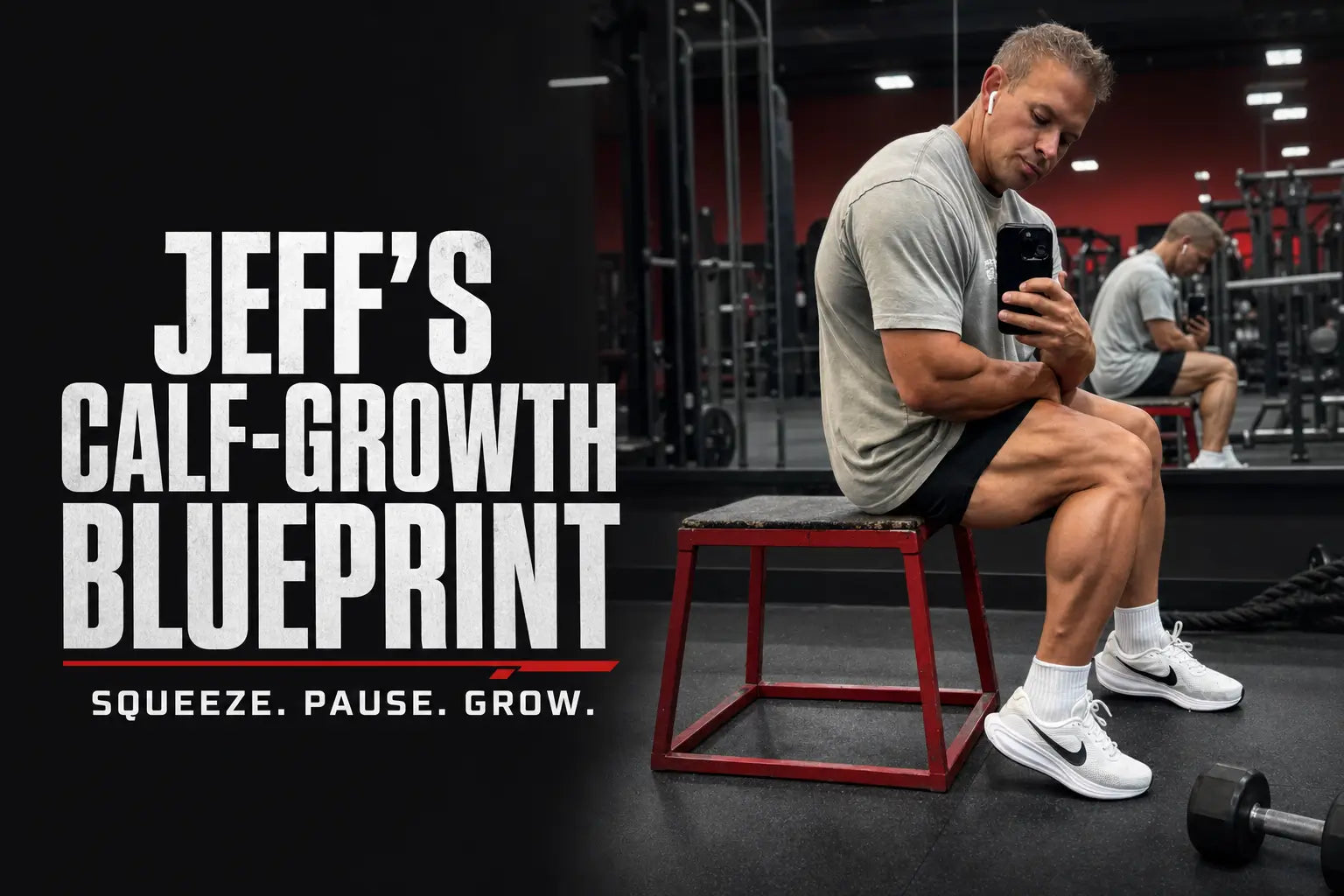

Calves can be stubborn—but complicated training usually isn’t the answer.
Jeff’s approach is built around three fundamentals:
The goal isn’t simply to move weight. It’s to make the calves do the work.
At the top of every calf raise, squeeze as hard as possible and pause briefly.
Don’t bounce out of the bottom or rush through the top. Drive through the balls of your feet, rise under control, and intentionally contract the calves.
Think:
Rise. Squeeze. Pause. Lower.
That short pause prevents momentum from carrying the repetition and makes the target muscle own the movement.
Train calves approximatelythree times per week, performing:
Spread the sessions across the week so the calves have time to recover between workouts.
A simple schedule could be:

You don’t need every calf exercise in the gym. Choose movements that allow you to stay stable, use a full range of motion, and contract the calves hard.
Use a standing calf-raise machine or Smith machine.
Standing variations place more emphasis on the gastrocnemius—the larger, more visible portion of the calf.
Keep your knees extended without aggressively locking them. Lower your heels into a comfortable stretch, rise as high as possible, and hold the top contraction.
Use a seated calf-raise machine or adapt the leg press.
The bent-knee position places greater emphasis on the soleus, which sits underneath the gastrocnemius and contributes to overall lower-leg thickness.
Avoid bouncing through the bottom. Keep the movement controlled and make the top position deliberate.
Tibialis raises train the muscles along the front of the lower leg.
Perform2–3 sets in addition to your 6–8 calf sets. Lift the toes toward the shins, pause briefly, and lower under control.
Training both sides of the lower leg supports more complete development and balanced ankle strength.
After the primary work is complete, finish the last set of your chosen calf movement with controlled repetitions until technical failure.
Technical failure means you can no longer complete another repetition with:
Once the repetitions become partial, rushed, or momentum-driven, the set is finished.
When the session is over, stretch each calf forone to two minutes.
Use a wall, platform, or calf machine to create a steady stretch without bouncing. Breathe normally and allow the tension to decrease gradually.
This is the cooldown—not another strength exercise—so keep it controlled and comfortable.

Calf training responds well to strong contractions, sustained output, and a focused mind-muscle connection.
That makesOutsized V4 a natural complement to the session. It’s a stimulant-free pre-workout built to support blood flow, endurance, focus, and fuller pumps without relying on caffeine.
Mix one scoop with 12 ounces of water approximately 15–20 minutes before training, following the label directions.
Outsized won’t replace consistent training or progressive overload. It simply supports the environment for a focused, high-quality session.
Growing your calves doesn’t require a dozen exercises.
It requires better repetitions performed consistently:
Keep the plan simple. Make every contraction count. Then repeat it long enough to see what happens.
